


Senior IP decision-makers, specifically Chief Intellectual Property Officers (CIPOs), and partners at law firms and in-house counsel advising the ASX 200 companies, should read this article to understand: Australia’s intangible share and its 25-year trajectory. Intangible assets rose from about 65.5% of ASX 200 market capitalization in 2000 to a record 74% in 2025, a […]
Insights
AI as IP™ Framework: Reasonable Measures in the Age of Artificial Intelligence

Corporate Chief Intellectual Property Officers, General Counsel, and Chief IP Counsel should read this article to: Understand how “reasonable measures” in trade secret, patent, and copyright contexts are evolving as AI systems create, store, modify, and expose valuable intellectual property across technical and organizational layers Advise clients to build AI Asset Registers that document asset […]
Five Questions Policymakers Should Ask About Intangible Assets

Over the last fifty years, the global economy has experienced a profound shift in how value is created. In 1975, tangible assets represented approximately 83% of the market value of companies in the S&P 500. Today, intangible assets account for more than 90% of that value. This “economic inversion” reflects the growing importance of intellectual […]
Nine Ocean Tomo Experts Named to the 2026 IAM Strategy 300 – The World’s Leading IP Strategists
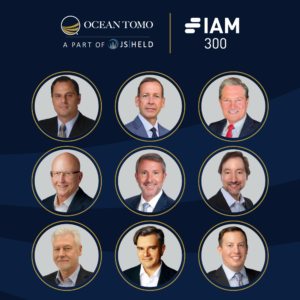
Ocean Tomo, a part of J.S. Held, has nine experts named to the 2026 IAM Strategy 300, the industry guide to the world’s leading intellectual property strategists. The honorees are Gregory Campanella, John A. Hudson, David Kennedy, Brian W. Napper, Larry Tedesco, Ozer Teitelbaum, Marek Wernik, Sam Wiley, and Ryan Zurek. Together they represent all […]
Ocean Tomo Insights Series: Strategies for Standard Essential Patents (Part 3 of 4)

This article is the third in a four-part Ocean Tomo Insights series focused on strategies for managing standard essential patent (SEP) portfolios, litigation, and licensing. Each installment addresses a specific stakeholder group including implementers, innovators, outside counsel, and suppliers. The articles explore how understanding SEP related technical analysis and FRAND royalty rates can support proactive risk assessment, strategy, and positioning in SEP disputes In this third article, we examine […]
12 Questions Boards, Executives, and Investors Should Ask About AI Assets

Artificial intelligence is rapidly becoming one of the most valuable assets many organizations own, yet it often remains largely invisible within traditional financial reporting, governance discussions, and investment analysis. Companies invest heavily in proprietary data, machine learning models, algorithms, and AI-enabled systems that create competitive advantage and enterprise value. However, many of these assets continue […]
Biotech Blues & The Not-So-Hidden Costs of Prior Art: Lessons in Pharma and Psychedelics

| This article was first published on les Nouvelles, March 2026 edition. In the high-stakes biotechnology and pharmaceutical industries, and in their emerging offshoots like the fast-growing psychedelics space, patents are both a cornerstone of innovation and a potential latent source of risk. At the heart of this dynamic lie prior art and freedom-to-operate […]
Software Reverse Engineering and Dynamic Testing for Evidence of Use

In a previous article, I introduced the three primary approaches for establishing Evidence of Use (EoU) in patent matters involving software and firmware: analysis of publicly available information, device and application testing, and reverse engineering. That piece outlined what each approach involves and when each is most appropriate. This article goes deeper into the software […]